
During a turn, the inner front wheel follows a smaller circle than the outer wheel and must steer through a greater angle. Toe-out on turns is the measured difference that allows both tires to roll around a common turning center.
The inner wheel must turn more sharply than the outer wheel.
The relationship is created mainly by steering-arm geometry.
Toe-out on turns is a diagnostic check, not a normal tie-rod adjustment.
Turn-plate accuracy and steering centering are critical.
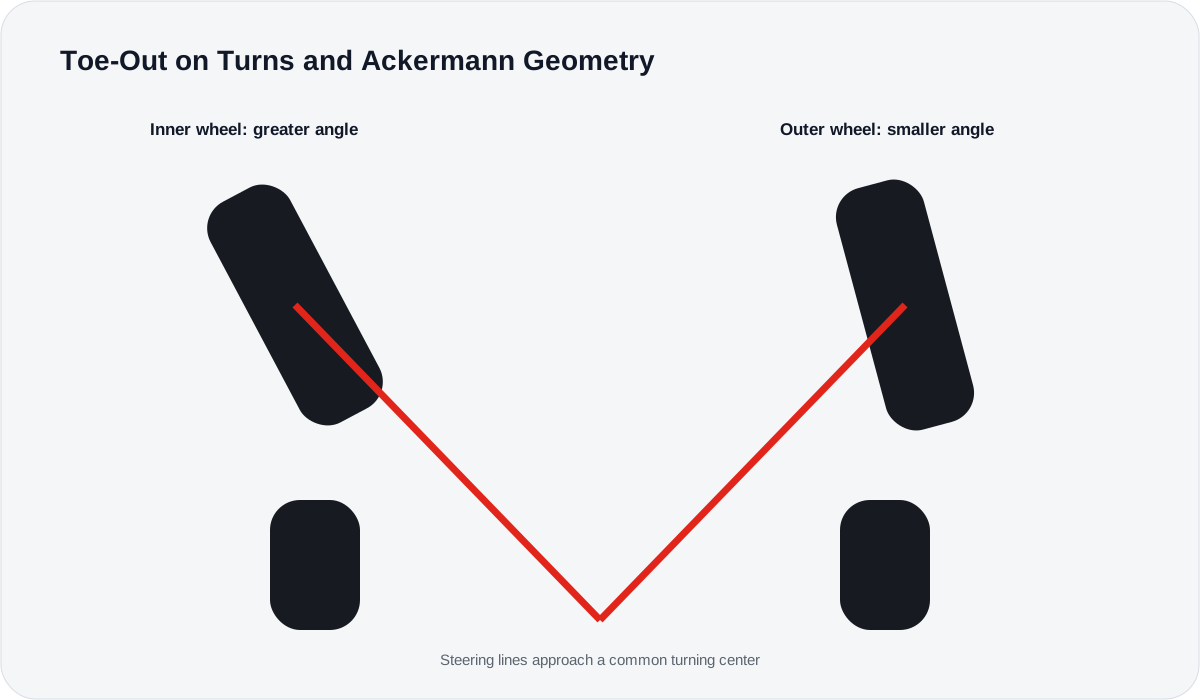
Ackermann steering principle
If both front wheels turned through the same angle, one tire would have to scrub because the inner and outer wheels travel on different-radius paths. Steering arms and linkage are arranged so the inner wheel gains more angle as the steering moves away from center. The ideal relationship is often illustrated by lines from the steering arms meeting near the rear-axle center.
Real vehicles may depart from ideal geometric Ackermann to balance tire behavior, suspension compliance and handling. Use the vehicle specification rather than assuming a universal angle difference.
How toe-out on turns is measured
The wheels are placed on turn plates and steered to a specified angle on one side. The aligner compares the angle of the inner and outer wheels. The procedure is repeated in the opposite direction when required. The steering wheel must begin near center and the plates must be centered, level and free.
| Measurement problem | Possible effect |
|---|---|
| Turn plates not centered | Available travel or indicated angle can be incorrect. |
| Plate binding | Wheel does not reach natural steering position. |
| Steering wheel begins off center | Left/right comparisons become misleading. |
| Bent wheel or uncompensated clamp | Wheel-angle calculation can be affected. |
What an abnormal value can indicate
- Bent steering arm or steering knuckle.
- Incorrect steering component installed.
- Damaged center link, rack or relay linkage.
- Unequal tie-rod or rack-centering condition.
- Structural damage affecting steering-pivot position.
- Measurement error caused by plate or sweep conditions.
Why normal toe adjustment does not correct it
Normal tie-rod adjustment changes the straight-ahead position of the wheels. Toe-out on turns comes mainly from the relative position and length of steering arms and linkage pivots. Adjusting toe to hide an abnormal turning relationship will create incorrect straight-ahead toe and tire wear.
Best practices
- Verify front toe and steering center first.
- Center and unlock the turn plates.
- Follow the specified steering angle shown by the software.
- Avoid forcing the steering against a stop unless instructed.
- Compare left-turn and right-turn results.
- Inspect steering arms and linkage if the result is repeatably outside range.
Frequently asked questions
Is toe-out on turns the same as static toe-out?
No. Static toe is measured near straight ahead. Toe-out on turns describes the difference between inner and outer steering angles during a turn.
Can a steering-wheel alignment problem affect the test?
Yes. Beginning away from the steering center changes the left/right comparison and can place the rack at unequal positions.
Do all vehicles use perfect Ackermann geometry?
No. Manufacturers may use a modified relationship to achieve the desired tire and handling behavior.
Technical content reviewed for TreadPlus Learn v1.0 · Updated July 16, 2026